Agents
Experimental in 0.6.x. The agent API, the agent fields of a key, and the audit columns of an agent may change in 0.7.0, with a note in Upgrading. They do not change inside 0.6.x without a note. What other tools may rely on in 0.6.0 is listed in What is stable.
An agent is a program or a hosted assistant that calls MCP tools with a key of its own: Grok Bot, a Copilot Studio agent, an AWS AgentCore gateway, a Cloudflare worker, a script. A key that belongs to an agent has three more properties than a personal key:
- It has a scope: a list of MCP servers and tools. The agent may use only what its owner's AccessRules allow and its scope lists. A new agent has an empty scope, which means no tool.
- Every call it makes is recorded with the agent, its mode, the platform it declared and its owner at the time the key was issued, so Audit can answer "which assistant did this, and for whom".
- It can be limited to source address ranges, so a key stolen from a platform's configuration does not work from another network.
Agents add no budget and no limit of their own. Budgets count model requests only, and MCP calls are not counted by any limiter in 0.6.0. See Limits that apply.
Two kinds of agent
| Person mode | Itself mode | |
|---|---|---|
| Who creates it | Any signed-in person, for themselves | Admins only |
| Who it acts as | Its owner: the same email, groups, AccessRules, budgets and offboarding as the owner's own keys | A service account <name>@svc.ambit.internal with one group |
| Owner | The person who created it. It never changes. | A person or a group (group:platform) that is accountable for it. An admin can move it. |
| Keys | Up to 2 live keys, end date up to agents.keyMaxDays (default 90 days). They stop when the owner has not signed in for apiKeys.inactivityDays, as personal keys do. | Up to 2 keys (the account's limit), end date up to agents.keyMaxDays. They do not stop for inactivity. |
| App connections | Only the apps the owner ticked for this agent (see Apps with a person's own sign-in) | None in 0.6.0 |
There is no delegation: an agent never acts for a person other than its owner. A team that wants one shared assistant uses one itself-mode agent, which Audit shows as that service account, never as a person. If every person should act as themselves, each makes their own person-mode agent.
The Agents page
You → Agents in the console lists the agents you may see: your own, and for admins every agent. Each row shows the owner, the declared platform, the kind (person or itself), the last use, the tools the agent may use (its scope) and its state.
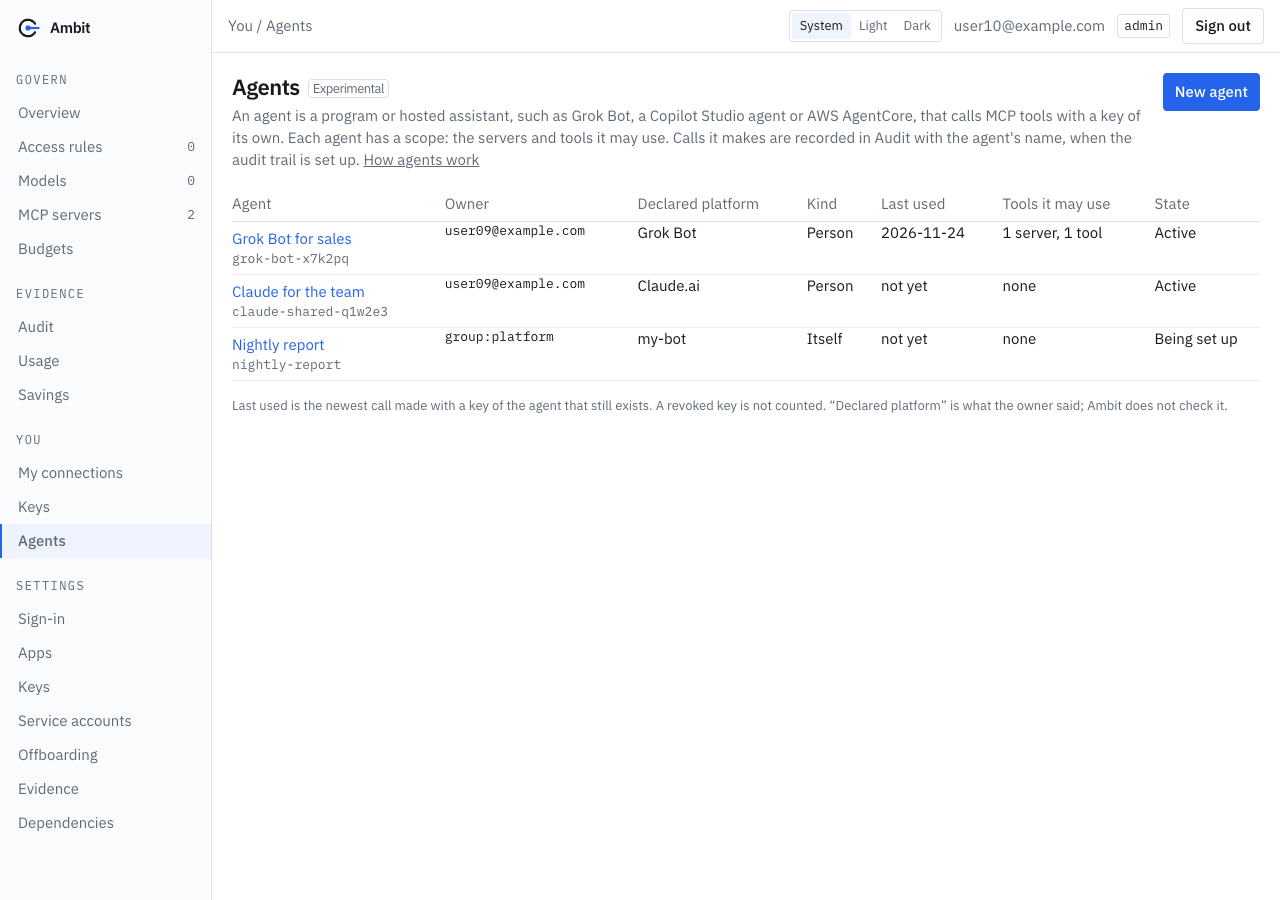
- Declared platform is what the owner said the agent is. Ambit does not check it, and no rule, limit or bill uses it. The console and Audit always call it "declared".
- Last used is the newest call made with a key of the agent that still exists (a revoked key is not counted). If the console has no audit trail (ClickHouse is not set up), it says "unknown", and says why.
- Tools used (the calls of the last 30 days, counted per tool) are on the agent's detail page, for admins, because they come from the audit trail, which only admins may read. A person sees a note that admins can look it up in Audit.
- No agents yet shows a short explanation and the New agent button. When your administrator has switched agents off, the page says so and has no button.
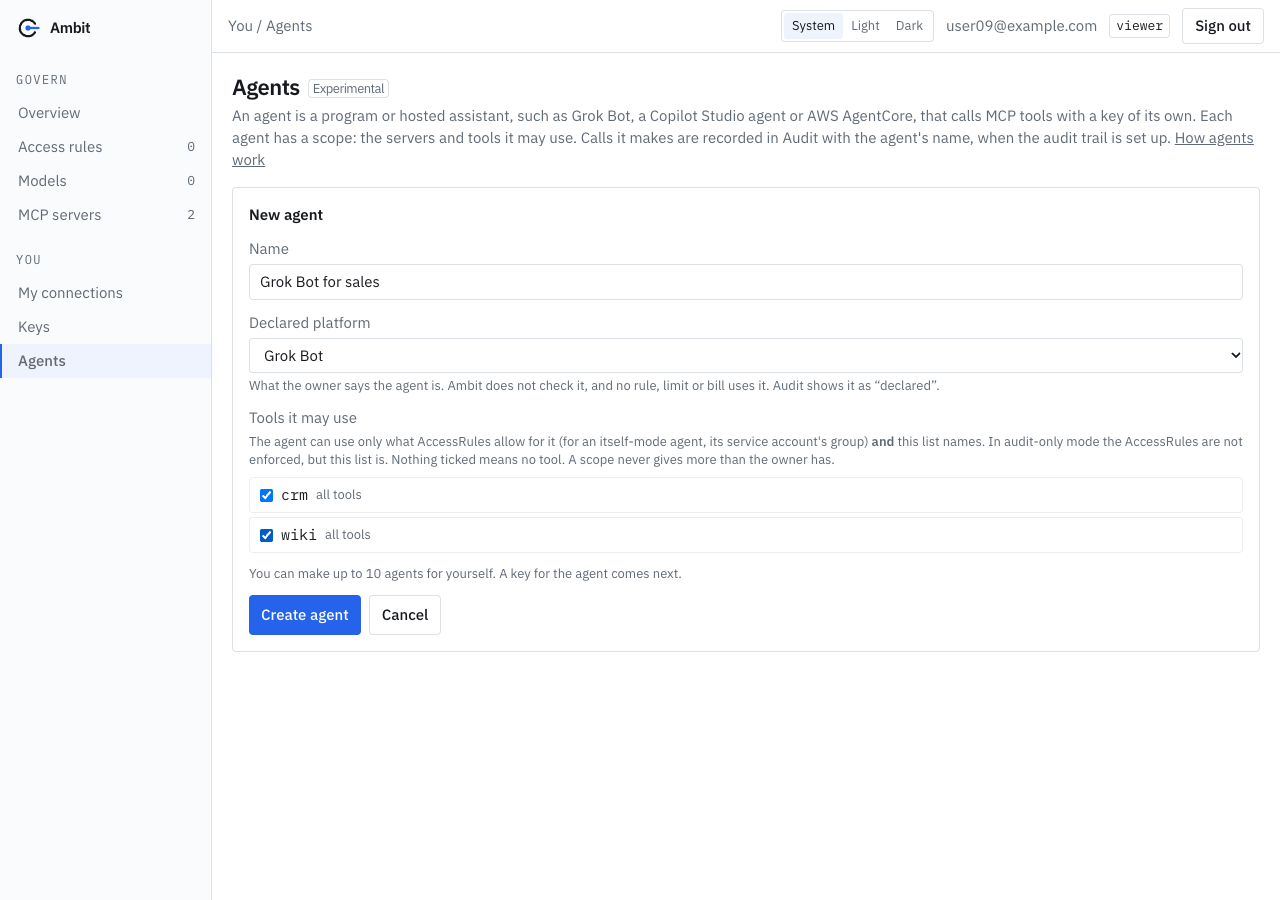
New agent asks for a name, a declared platform and the tools the agent may use. Nothing ticked means no tool. A
person makes agents for themselves only. Admins also see the choice Itself, which makes a service account with an
owner (a person or group:name), a group and an account name.
The detail page shows the agent's facts, its scope (with Change), and its keys. New key asks for a key name, an end
date and, if you want, source address ranges. The key is shown once, together with the MCP URL and the two header forms
(Authorization: Bearer and x-api-key). The page never shows it again: it keeps only the start of the key.
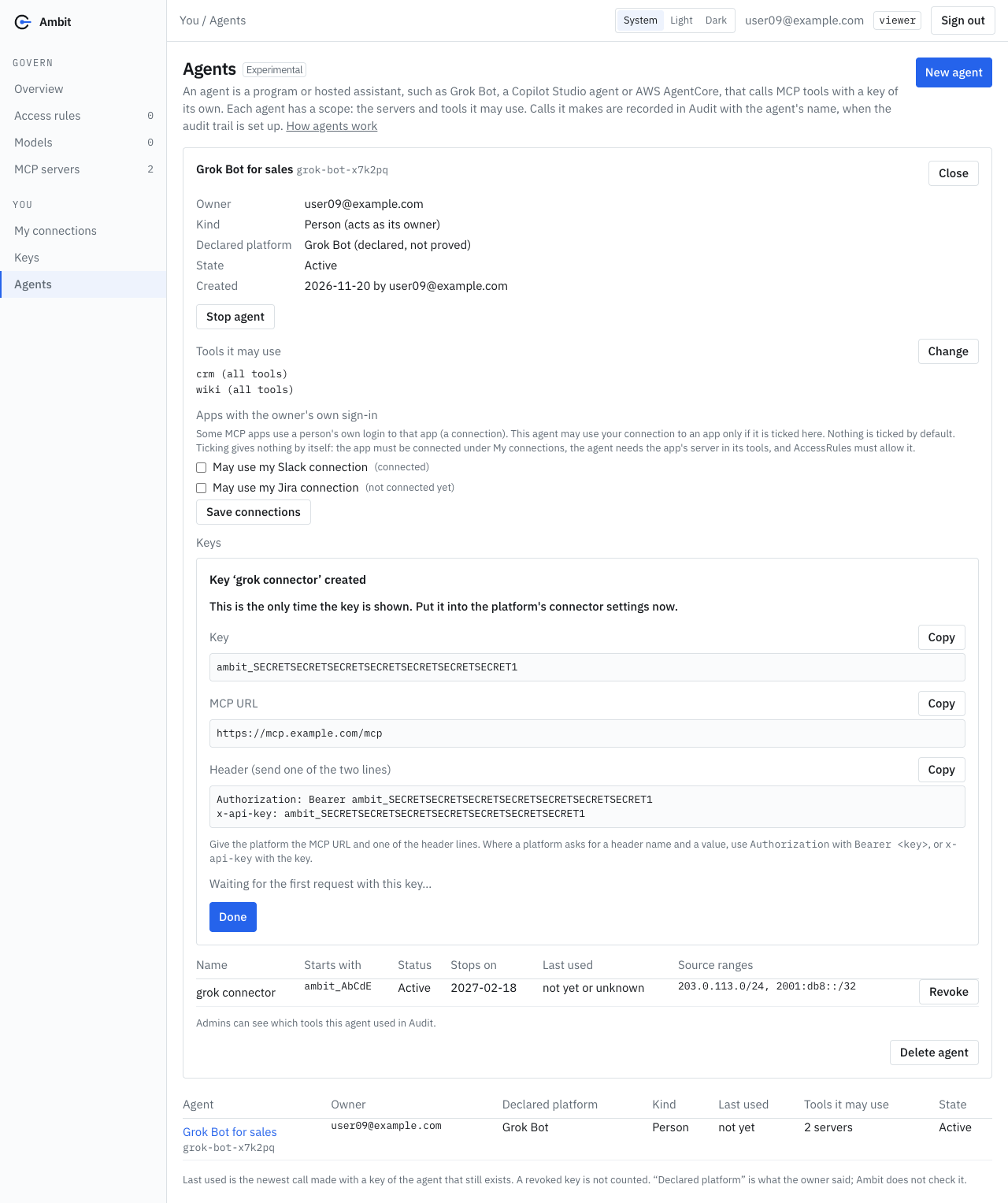
Revoke deletes one key. Delete agent deletes the agent, its keys and (itself mode) its service account.
Stop and start
Stop agent is on the detail page, for the owner (person mode) and for admins. The page asks first, and says what a stop is: the console starts to delete the keys at once, and the page shows Stopped only after every gateway has confirmed the stop. While it waits, the agent is Stopping, the page asks again every 2 seconds, and it says that a call that is already on its way can still be accepted. It never says that no call is accepted: the console measures the calls that were accepted after the request (see Stopping an agent).
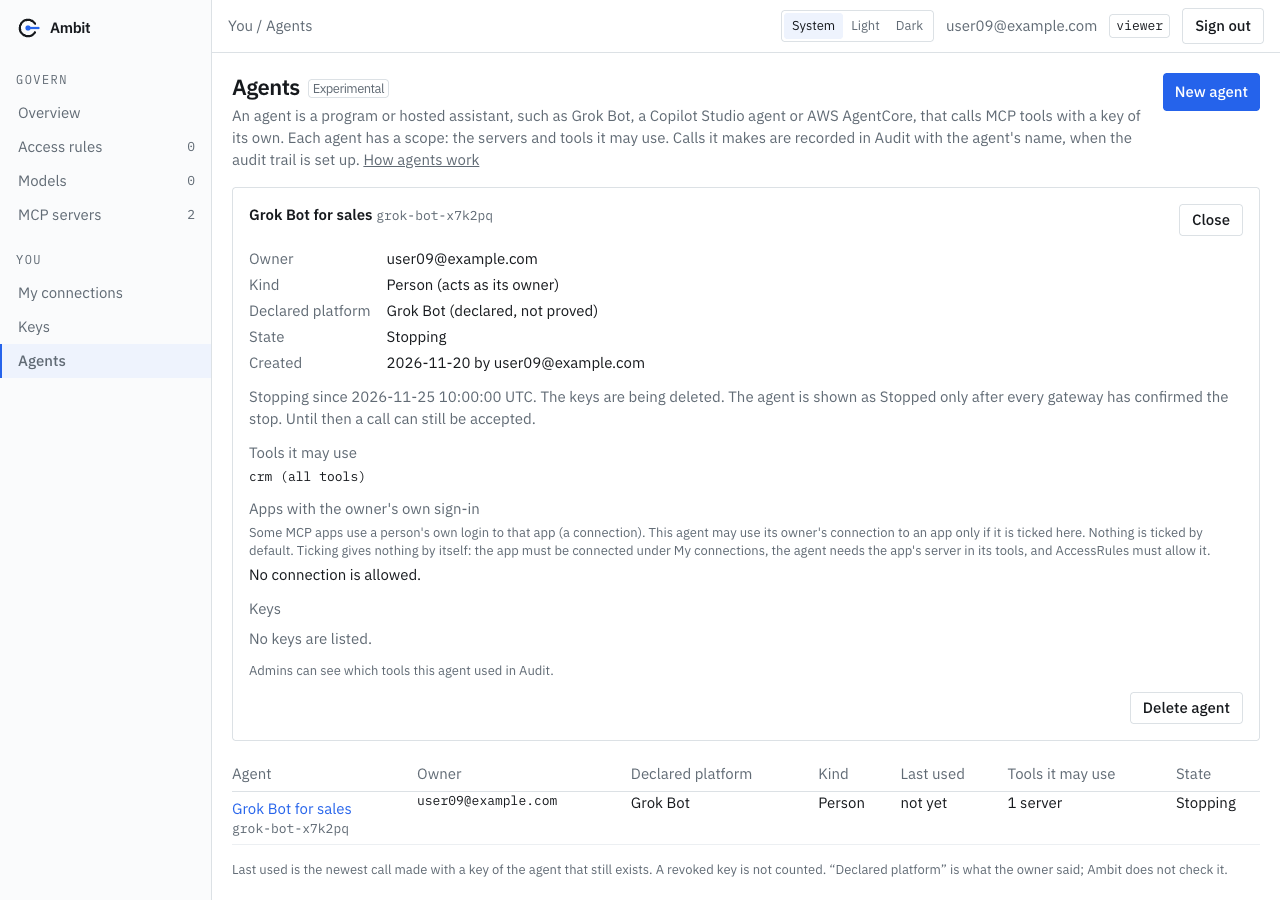
When the stop is confirmed, the page shows the time and how many seconds after the request it was confirmed, as the console
measured it. If a gateway has not confirmed after 60 seconds, the page says so, and says that the steps are repeated until it
does. If the stop list is full, it says that too. Admins get a link to the stop evidence (agent-stop.zip): the time of
each step, each gateway's confirmation and the calls accepted after the request, counted.
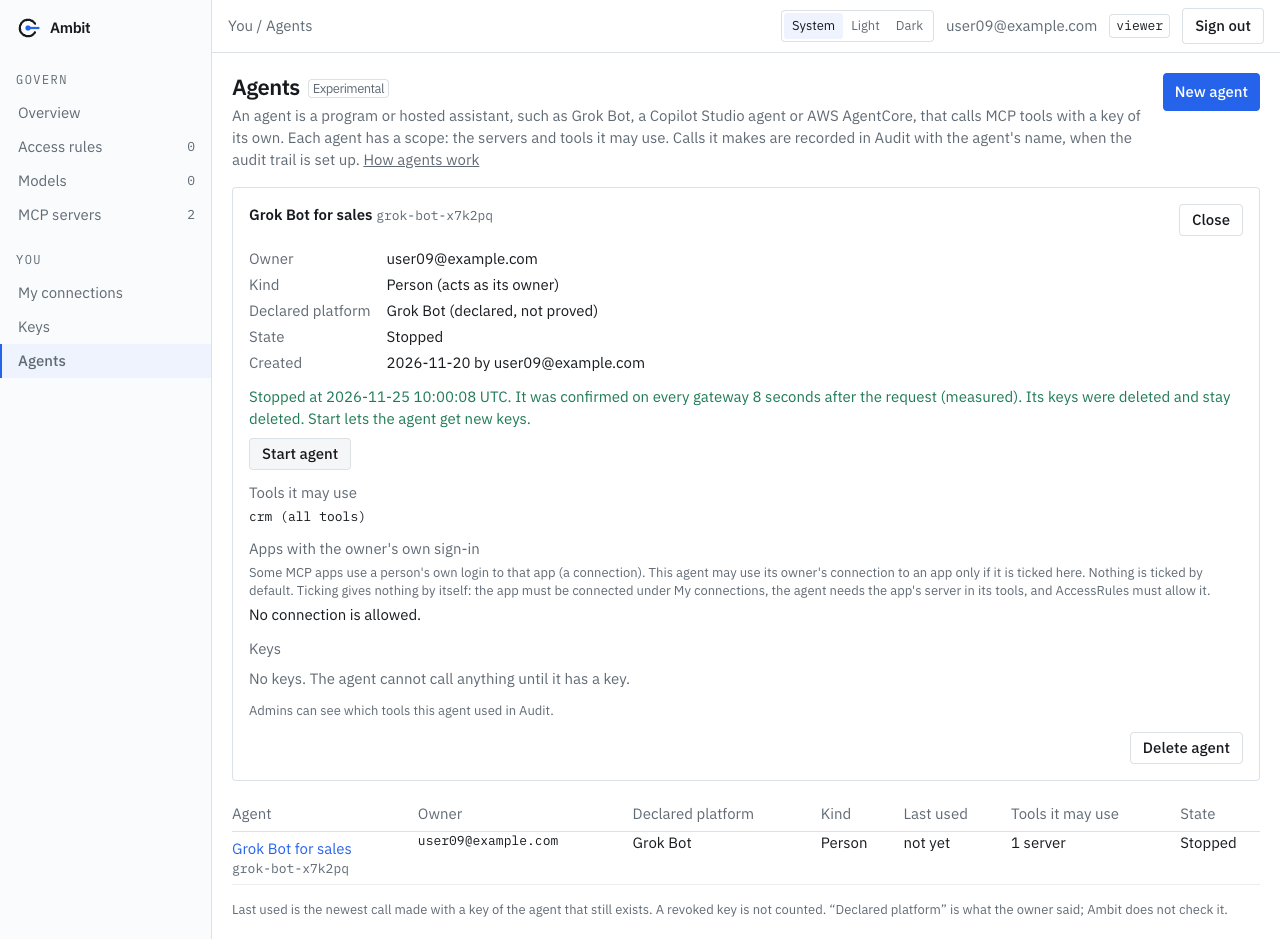
Start agent lets a stopped agent get new keys. The old keys stay deleted. The console refuses a start for one minute after the keys were deleted, and the page shows its reason.
Apps with the owner's own sign-in
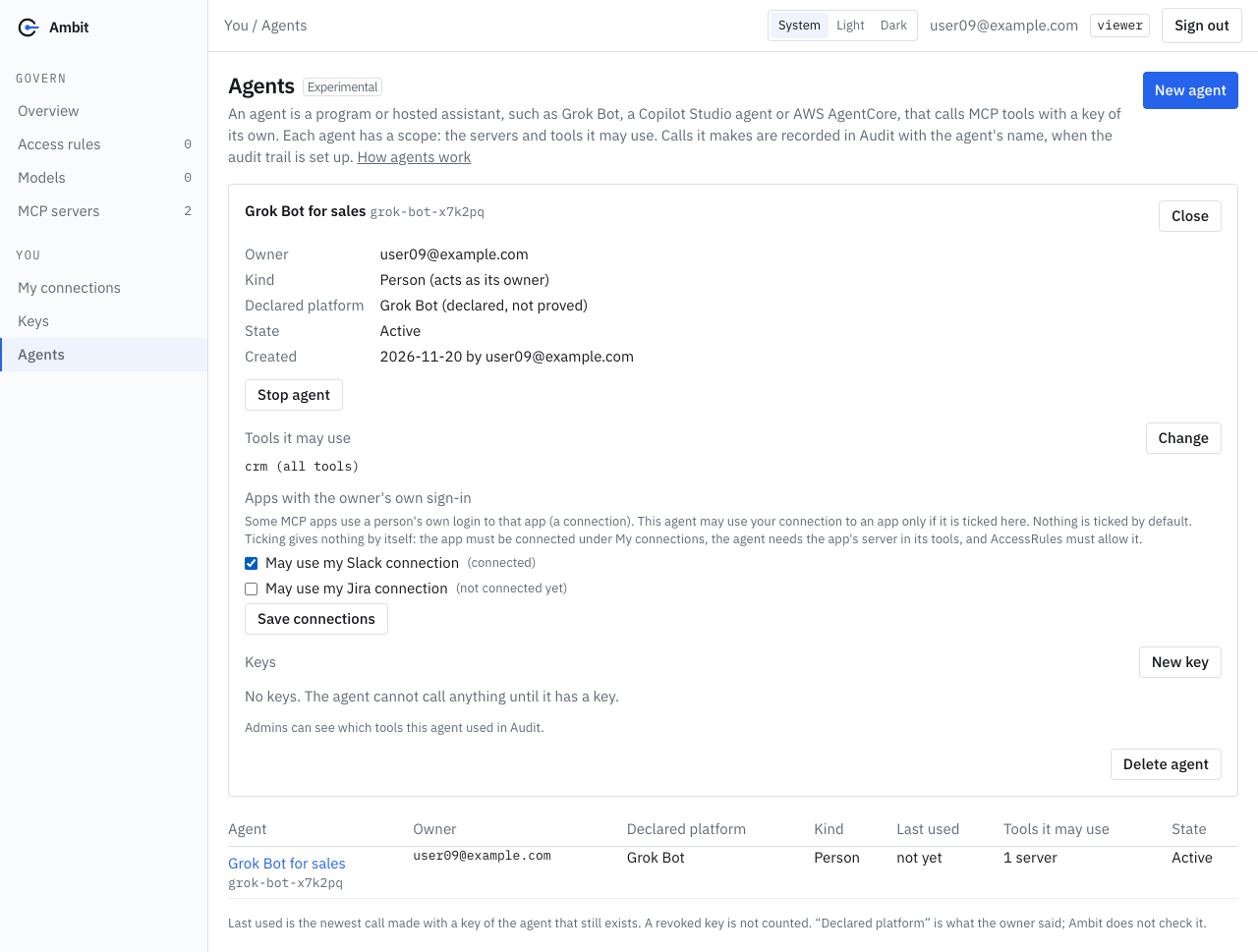
For a person-mode agent, the owner sees one box for each of their connections: May use my Slack connection. Nothing is
ticked by default. Save writes connectionConsent. A box gives nothing alone: the app must be connected under My
connections, the agent needs the app's server in its tools, and AccessRules must allow it. Only the owner changes the boxes;
an admin sees the list. An itself-mode agent gets no app connections in 0.6.0.
When the owner leaves
An agent whose owner left shows a banner with the date. It keeps working for the time set in agents.orphanDays (7 days by
default), then it is stopped. An admin moves an itself-mode agent to a new owner in the banner.
Create an agent and a key in the API
The same, with the API:
# as a signed-in person: an agent for yourself (the name is made from the display name)
curl -s -b "$COOKIES" -X POST "$CONSOLE/api/agents" -H 'Content-Type: application/json' \
  -d '{"displayName":"Grok Bot for sales","platform":"grok","scope":["crm/read_contact","wiki"]}'
# a key for it: shown once
curl -s -b "$COOKIES" -X POST "$CONSOLE/api/agents/grok-bot-for-sales-x7k2pq/keys" -H 'Content-Type: application/json' \
  -d '{"name":"grok connector","days":30,"sourceRanges":["203.0.113.0/24"]}'
An admin creates an itself-mode agent with a service account of its own:
curl -s -b "$COOKIES" -X POST "$CONSOLE/api/agents" -H 'Content-Type: application/json' \
  -d '{"mode":"itself","name":"nightly-report","displayName":"Nightly report","group":"ops","owner":"group:platform","platform":"agentcore","scope":["reports"]}'
curl -s -b "$COOKIES" -X POST "$CONSOLE/api/agents/nightly-report/keys" -H 'Content-Type: application/json' \
  -d '{"name":"report job","days":90}'
Give the key to the platform as an MCP header: Authorization: Bearer ambit_... or x-api-key: ambit_.... The URL is the
MCP URL of your install (mcp.host).
- Scope. A list of up to 50 entries.
crmallows every tool of the servercrm;crm/read_contactallows one tool. A scope narrows the owner's rights; it never adds to them. Empty means no tool. - Platform. What the agent says it is:
chatgpt,claude-ai,gemini-enterprise,copilot-studio,grok,agentcore,cloudflare,orca,other, or any other lower-case word (up to 40 characters). It is declared, never proved. No policy, limit or bill uses it. - Source ranges. Up to 10 CIDR ranges per key (
203.0.113.0/24,2001:db8::/32). A key with ranges is accepted only from an address inside one of them. Which address the gateway sees depends on how traffic reaches it (a load balancer that hides the client address makes every request look like one address; set the ranges only when you know the address the gateway sees). - Changing the scope or the platform rewrites the metadata of the agent's keys, and the gateway uses the new scope as soon as it has read the changed key (about a second on kind; see Measured). If some key could not be updated, the request fails with 503 and the saved change is finished by sending the same request again, or by the hourly repair.
- Narrowing a scope is enforced first: the keys are narrowed, and only then is the new scope saved. If a key cannot be narrowed, nothing is saved (503) and the old scope stays; send the request again.
- Deleting an agent first records state
deleting(no new keys), then deletes its keys, its service account (itself mode; the name stays taken) and its record. If a step fails, the same request, or the hourly repair, finishes it. - A person-mode agent's keys are the person's keys too: they count among the person's 20 keys, appear in Keys, are
revoked by
DELETE /api/keys/{id}and are deleted when the person is offboarded.
What the gateway checks
For an agent's key the gateway checks, in this order, and answers 403 when one fails:
- The key is valid and has not ended (as for every key: How the gateway checks a key).
- If the key has source ranges, the client address is inside one of them.
- The owner is not on the offboarding block list.
- For each MCP call: the owner's AccessRules allow the tool and the key's scope lists its server or the tool.
The scope is in the key's metadata (apiKey.agentScope), not in the access policy, so the policy has the same length
with 0 agents and with 2,000 agents. A key of an agent that has no scope list at all, or whose scope is not a list, may
use no tool.
Audit-only mode (access.mode: audit) relaxes the owner's AccessRules only. An agent's scope is part of its key, not
an AccessRule, so it stays enforced in audit-only mode.
No key before the gateway enforces the scope. The controller publishes in ambit-access-mode (agentScope: "1") that
the MCP policy in force has the scope clause, after agentgateway applied it. Until then the console refuses to create an
agent key (503, "agents are not ready"). So a console that is upgraded before the controller, or a policy that
agentgateway rejected (for example because it grew over the 16,384-character limit), never gives out a key that the
gateway would not limit.
Stopping an agent
Stop an agent when it misbehaves, when its platform is compromised, or when its owner leaves. A stop is a state machine, not a switch: Ambit reports an agent as stopped only after every Gateway has confirmed the stop. It never promises that no call is accepted after the request; it measures how many were.
curl -s -b "$COOKIES" -X POST "$CONSOLE/api/agents/grok-bot-for-sales-x7k2pq/stop" -H 'Content-Type: application/json' -d '{}'   # 202
curl -s -b "$COOKIES" "$CONSOLE/api/agents/grok-bot-for-sales-x7k2pq"                                                       # "state": "stopped" when confirmed
curl -s -b "$COOKIES" -X POST "$CONSOLE/api/agents/grok-bot-for-sales-x7k2pq/start" -H 'Content-Type: application/json' -d '{}' # a stopped agent gets new keys again
The owner (person mode) or an admin stops an agent; admins also stop itself-mode agents. Stopping works when agents.enabled is
false.
 active --Stop--> stopping --S2, S3 done, every Gateway confirmed--> stopped --Start--> active
                  |  ^
                  |  +-- the steps are repeated every 2 s until they work
                  +-- after 60 s without confirmation: event, alert "stop not confirmed on <Gateway>"
| Step | Who | What |
|---|---|---|
| S1 | console | Writes the agent to the stop list (ConfigMap ambit-agent-stops, a new list generation) and records state stopping |
| S2 | console | Deletes every key of the agent (also a key made while it is stopping) |
| S3 | console | Revokes the agent's OAuth grants (none before OAuth) |
| S4 | controller | Renders the list into Require policies ambit-agent-stops-<k> on every MCP and LLM route of every Gateway (at most 150 agents per policy) |
| S5 | controller | Reads each policy's status per route: a Gateway acknowledges the list generation when all its routes accepted every policy at its current generation (plus the settle time, --activation-settle). The answer is in ConfigMap ambit-agent-stops-ack |
| S6 | console | State stopped when S2 and S3 are done and every Gateway acknowledged the entry's generation. Writes the History event |
The stop policy is the authoritative check for every credential the gateway accepts: a key of a listed agent is refused (403) by the gateway even while its Secret still exists, and so is a token that names the agent or its grant. Deleting the keys (S2) is the second line.
Where the acknowledgment comes from. Each policy is attached to routes, and agentgateway reports per route whether it accepted
and attached the policy at its current generation. A Gateway is ready only while every policy of the list's current generation
is accepted on its routes, has not been rejected by a proxy since it was written (the Gateway's NACK events) and has
settled (--activation-settle, 3 s: agentgateway v1.7.0 has no acknowledgment from the proxies that a controller can read).
If a stop policy is edited, deleted or rejected afterwards, the Gateway is no longer ready, and the console neither completes nor
prunes a stop until it is. The answer is bound to the stop list it was made for (its UID) and only the controller may write it
(admission policy ambit-agent-ack-writer). A route that is attached to more than one Gateway counts for each of them.
The controller renews its answer every 30 s while the list has entries; the console treats an answer older than two minutes as no
answer, so a controller that is down cannot leave an old "ready" in force (the agent stays stopping). Both stop ConfigMaps
(ambit-agent-stops, ambit-agent-stops-ack) are fenced by name: only the console writes the list and only the controller the answer, labelled or
not. The names stops and stops-ack are reserved and cannot be the name of an itself-mode agent (their records would be these ConfigMaps).
The list is stable. An entry has a fixed slot (0 to 999) and is in policy slot ÷ 150; adding or removing an entry never moves another one to another policy, so a change of one policy never takes a still-listed agent out of the block.
Start. start removes the entry. It is refused (409) for one minute after the keys were deleted, so that the proxies have dropped
them; with OAuth it waits for the whole retention, because an access token already issued stays valid until it expires.
Retention. An entry stays in the list until the agent's credentials are gone, every Gateway acknowledged it, and
agents.stopRetentionMinutes (25: the access token life of 15 minutes and 10 minutes of leeway) have passed. Then it is
pruned; the agent record keeps state: stopped. Start removes the entry at once.
Fail closed.
- The controller never deletes a stop policy while an entry exists. If the list cannot be rendered (more than 1,000 entries, an unreadable list), it keeps the policies in force, writes
degradedinto the acknowledgment and sets the alertAmbitStopPolicyDegraded. - A partial rollout (one Gateway confirmed, another not) stays
stopping, and the alert and the event name the Gateway that is late. - If the list is full (1,000 entries), the stop still runs S2 and S3, the agent is marked
stopUnlisted, and it staysstoppinguntil there is room (the console tries every 2 s). Keys are gone; tokens (with OAuth) expire within 15 minutes.
The limits, stated honestly. What a stop can and cannot do depends on what is working:
| Failure | Keys | Measured |
|---|---|---|
| none | refused after the proxies learn of the policy and the key deletion | refused 0.92 s after the request (p50; p95 0.94 s, p99 0.94 s, max 0.94 s in 20 runs); a client calling every 25 ms had 36 calls accepted after the request (max 37); reported stopped after 8.3 s |
| Ambit controller down | refused after S2 as usual; the stop is not confirmed (state stays stopping) until it is back | key refused after 0.73 s (29 accepted calls in between); the agent stayed stopping and was reported "not confirmed" after 60 s; confirmed after the controller was back |
| agentgateway controller down | not refused until it is back: the proxies keep their last configuration | in the first 20 s 874 calls with the deleted key were accepted (none refused); the first refusal came 30.7 s after the request, when the control plane was back |
| console down | a stop cannot be requested. Emergency stops: the Helm values apiKeys.enabled: false (all keys) and agents.enabled: false | not applicable |
Measured on kind with agentgateway v1.7.0, one gateway pod, a polling client with the key (test/stepagents.sh, 2026-11-25). Real clusters
with more proxy pods, a network and a load balancer will differ; run the test on yours before you rely on a number. A controller restart during
a stop delayed the confirmation to 26.4 s. A partial rollout across two Gateways is covered by the controller's tests (one Gateway ready, the other not: the agent stays stopping).
An OAuth access token is checked offline by the gateway; once OAuth exists, a token stays valid until it expires (at most 15 minutes) when no stop policy applies.
Evidence. GET /api/evidence/agent-stop/<agent>.zip (admins, needs evidence.enabled) holds timeline.csv (request, keys deleted,
grants revoked, each Gateway's acknowledgment, stopped, with seconds from the request), calls-after-request.csv (every call that
carries the agent's name from the request on, with its status) and summary.csv: the measured number of accepted calls after the
request, and the time to the first refused call, per Gateway. There is no "expected 0" column. A call with a key that was already
deleted is logged as an invalid key without the agent's name, so it is not in the file; a refusal by the stop policy is.
When the owner leaves. Offboarding stops all of the person's person-mode agents with this state machine.
Their itself-mode agents are marked orphaned: they keep working for agents.orphanDays (7), with orphanedAt in the
record, so that an admin can move them (PUT /api/agents/{name}/owner); then they are stopped.
Audit
Every record of a call made with an agent's key has these attributes in otel_logs (LogAttributes), taken only from
the verified key:
| Attribute | Meaning |
|---|---|
ambit.agent | The agent's name (empty for a call that is not an agent's) |
ambit.agent_mode | person or itself |
ambit.agent_owner_at_issue | The owner when the key was issued. It never changes. |
ambit.platform_declared | The platform the agent declared. Never a proof. |
ambit.grant_id | The OAuth grant (empty until OAuth is available) |
ambit.token_issuer | The validated issuer of a token (empty for keys) |
ambit.ingress | private or public: the Gateway that took the call. Written only with the public front door (frontDoor.enabled); empty without it |
Records written before this release do not have them, and keep exporting with empty cells.
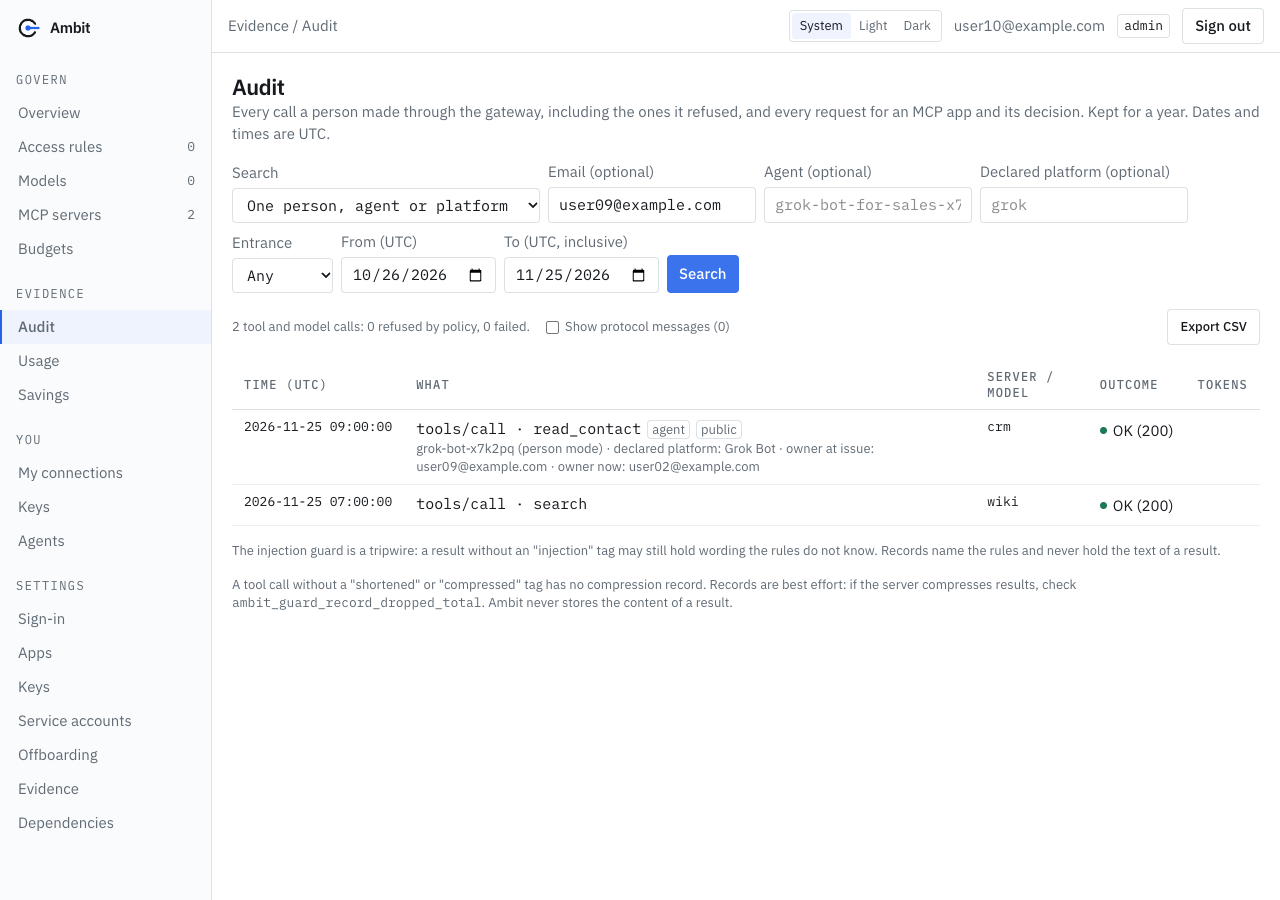
The Audit page (Evidence → Audit, admins) has the fields Agent, Declared platform and Entrance (private
or public) next to Email. An agent or a declared platform alone selects calls the way an email does, and then the email
is optional; the entrance only narrows one of them, so it is off until one of them is filled in. A call made with an agent's
key has an agent badge. Under it the row says which agent (and its mode), the declared platform, the owner when the key
was issued and, if the agent was moved since, the owner now. A call that came in through the public entrance has a
public badge. Export CSV has the same eight columns as calls.csv, after the columns it had before. Search Audit for
this agent on the agent's page opens the search for it.
The Audit API accepts agent=, platform_declared= and ingress= (private or public) next to email=. An agent or a
platform alone selects calls the way an email does; ingress only narrows another filter.
curl -s -b "$COOKIES" "$CONSOLE/api/audit?agent=grok-bot-for-sales-x7k2pq&from=2026-12-01&to=2026-12-08"
Each call in the answer has agent, agentMode, agentOwnerAtIssue, agentOwnerNow (the agent's record when you
read, so a moved agent shows both), platformDeclared, grantId, tokenIssuer and ingress. The evidence export
calls.csv appends the columns agent, agent_mode, agent_owner_at_issue, agent_owner_now, platform_declared, grant_id, token_issuer, ingress after call_id. The columns before them keep their place.
Apps with a person's own sign-in
A Connection lets a person use an MCP app with their own login to that app. A person-mode agent may use the
person's connection only for the apps the person ticked for that agent. The list is the agent's connectionConsent
(names of Connections; empty by default), set with PATCH /api/agents/{name}:
curl -s -b "$COOKIES" -X PATCH "$CONSOLE/api/agents/grok-bot-for-sales-x7k2pq" -H 'Content-Type: application/json' \
  -d '{"connectionConsent":["slack"]}'
How it is checked, on every request that needs a connection token:
- The gateway names the calling agent to the token broker in the header
x-ambit-agent. The gateway computes it from the verified key (or token), never from a header of the client: a client's ownx-ambit-agenthas no effect. A person's own key or token gets the value-. - The broker reads the agent's record each time (no cache). It gives the owner's token only when the record is readable and
signed by the console, the agent is active and in person mode, the agent's owner is the person the gateway named, and the
connection is in
connectionConsent. - In every other case (no header, an unknown or unreadable record, a stopped agent, an itself-mode agent, no consent) the broker gives no token. The app then decides what to do with a request that has no token: it normally refuses, and the gateway leaves that server out of the agent's session. If every server of a session refuses, the session itself can fail to open (agentgateway v1.7.0 opens a session only when at least one server answers).
Consent alone gives nothing: the person must have connected the app themselves (My connections), and the agent still needs the server in its scope and in the owner's AccessRules. An itself-mode agent gets no app connections in 0.6.0. The gateway's policy that sends the header is generated by the Ambit controller; until the controller of this version has written it, no connection token is given to anyone (the broker refuses a request without the header).
Limits that apply
| Limit | Applies to | Counted by |
|---|---|---|
| Model budgets (requests per day, dollars per day, requests per minute) | The model calls of a person-mode agent count as its owner; an itself-mode agent counts as its service account, one person of its group | The ratelimit service, as today |
agents.maxTotal (2,000 agents), agents.maxPerPerson (at most 10 person-mode agents) | Creating agents | The console |
| Keys per agent: 2; source ranges per key: 10; scope entries per agent: 50 (each at most 200 characters); connections per agent: 20 | Creating keys, changing agents | The console |
No limit counts MCP calls in 0.6.0, for agents or for people (Budgets). Agents have no spending limit and no call limit of their own.
Where it is stored
| Object | Where | Bound |
|---|---|---|
| Agent record | One ConfigMap ambit-agent-<name> (label ambitproject.dev/agent), no secrets. Only the console may write it (admission policy ambit-keys-writer). | 16 KiB each (50 scope entries of the longest allowed length need about 11 KiB); 2,000 in all |
| Agent key | A key Secret, as every key, with the label ambitproject.dev/agent=<name> | As keys |
| Key metadata | agent, agentMode, agentOwnerAtIssue, platformDeclared, agentScope, agentRev, sourceRanges | Under 16 KiB with the largest scope |
Each record carries a signature that only the console can make (HMAC with a key derived from the console's session key). A record without a valid signature, planted or changed by anything else, is not an agent: it is ignored, and the hourly repair deletes it.
The console fails closed. When the agent records cannot be read, no key is created. The hourly repair deletes the keys of
an agent whose record is missing, unreadable or not active, finishes a delete that stopped half way (state deleting),
and deletes an itself-mode record that never got bound to its service account (state pending for more than 10
minutes). An itself-mode record is bound to its service account's owner record (by UID): it never acts on another
account of the same name.
When the limit is reached the create request answers 409 agent limit reached and nothing else changes.
What is stable
Everything on this page is experimental in 0.6.x. A later release may change it, with a note in
Upgrading. What other tools may rely on in 0.6.0 is the ambit_ key format (unchanged), the seven audit
attributes above, and the columns appended to calls.csv.
Public API (experimental)
| Endpoint | Who |
|---|---|
GET /api/agents (add ?all=true for every agent) | The caller's agents; admins for all |
POST /api/agents | Any signed-in person (person mode); admins (itself mode) |
POST /api/agents/{name}/stop, POST /api/agents/{name}/start, GET /api/evidence/agent-stop/{agent}.zip | The owner (person mode) or an admin; admins for itself mode and the export |
GET /api/agents/{name}, PATCH /api/agents/{name}, DELETE /api/agents/{name} | The owner (person mode), admins (itself mode; and delete for any agent) |
POST /api/agents/{name}/keys | The owner (person mode), admins (itself mode) |
PUT /api/agents/{name}/owner | Admins, itself-mode agents |
GET /api/audit?agent=&platform_declared=&ingress= | Admins |
Answers to people who may not see an agent are 404, not 403, so a name is not confirmed.
The Agents page and the Audit filters use only the endpoints on this page and the key endpoints of Personal API keys (GET /api/keys, GET /api/admin/keys, DELETE /api/keys/{id}, DELETE /api/admin/keys/{id}). They have no private API.
Measured
The scope and source-range checks run in the gateway's own policy engine, with no call to another service. The numbers of
the end-to-end test (test/stepagents.sh) and of the 2,000-agent test are in the pull request that added them.
See also: Personal API keys, Service accounts, Offboarding, Compliance and audits.